
An Angel’s Lament
A field of truth awaits

Bismillah al-Rahman al-Rahim
Forgive me if I don’t write here with sufficient anger or passion against the disasters engineered by Israel and America, or against their hate-filled genocide and aggression at this most repellent juncture of history. But let’s see, before the end of this writing, that may change.
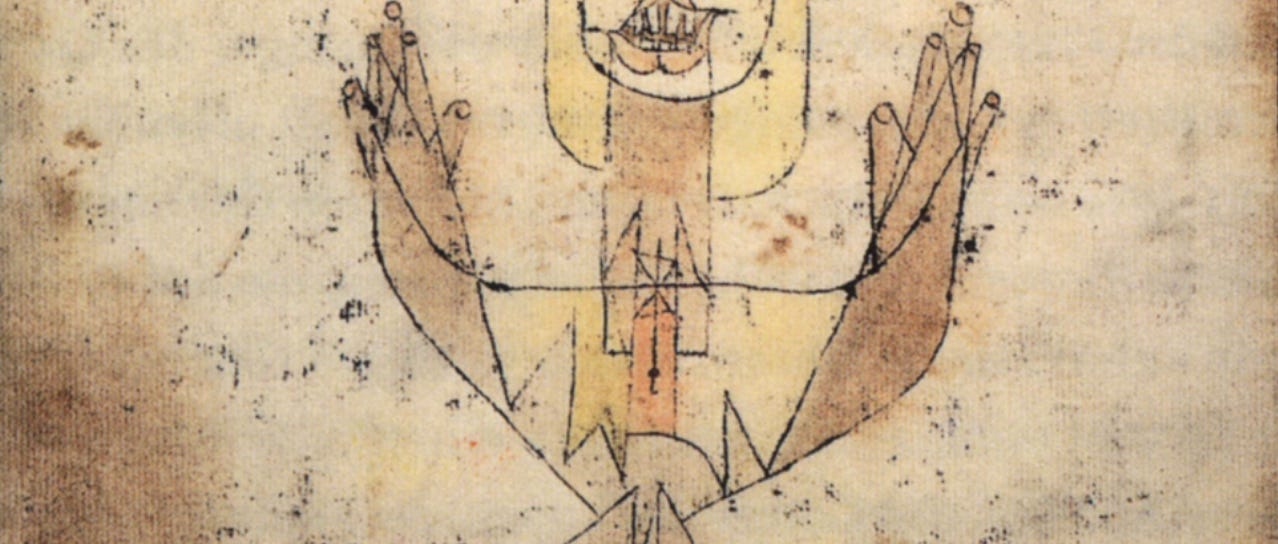
I feel now like what is depicted in Paul Klee’s artwork Angelus Novus whenever I think of Palestine, South Lebanon, Iran, and what is being imposed upon them. In Klee’s painting the angel of history is depicted as facing the past, eyes fixed upon catastrophe after catastrophe that keeps piling wreckage upon wreckage at his feet. He is unable to look towards the future but only backwards at what has slipped by, at disasters that have already occurred. So even as fresh calamities unfold, the angel can only react in horror to what appears, at what a tiny minority, a small unbalanced subset of men inflict needlessly upon humankind.
It endlessly witnesses the ugliness of what has been enacted, at the suffering exacted from innocent flesh and blood, and from the spirit of human beings. But since its vision can only encompass the present after it slips into the past, the angel can never act, only react. It is a reflection of us—no—it is a reflection of the passivity of horror that the wrecking crew of history hopes we will become.
What others call the march of progress, the angel sees as an unending accumulation of shattered homes, uprooted families, erased villages, broken promises, a people buried in rubble, and graves that stretch into the past and across generations. The angel perhaps longs to stop the perpetrators and their conscienceless machine-like march across history, and to awaken the oppressed dead and mend what has been torn apart, yet a storm drives him relentlessly (facing backwards) into a future which he cannot see, while the ruins grow ever higher as what has already passed appears to him.
There is great sorrow in this image, but also anger—an anger that we feel and which surely the angel feels, that arises from watching unnecessary tragedies become fixed within the fabric of history, and from seeing power excuse itself while ordinary people bear the endlessly rising cost.
Palestine is one open wound among many, where memory struggles to refuse burial, and where each new genocidal chapter is written atop debris that collects at the angel’s feet. But surely the angel also recognizes that since fresh debris from this land has not ceased to appear, it is a sign that the life of this struggle continues in the domain of the present in spite of the wreckage—a domain that the angel is unable to directly witness but can only infer from what appears to him. Surely, it wonders who these people are that dwell in the detritus of endless destruction through which generations have been forced to walk carrying grief upon grief, along with a numinous hope that this shattering arc of history can end and that even this catastrophe can ultimately mend.
Perhaps the message of Klee’s stunning work is that where the angel’s vision fails ours must begin. We are not restricted in scope like this suffering angel. The present is ours to participate in, the future is in the scope of our vision and our grasp.
The people of Palestine, of South Lebanon, of Iran, and of every land made to bear the weight of another’s domination, are not merely the latest fragments in the growing heap of history’s wreckage. They are living witnesses who continue to act, endure, remember, love, rebuild, resist, and uphold truth among a hurricane of lies.
All this within the very present that escapes the angel’s gaze. The ruins that accumulate at its feet are real, and so too is the grief that overwhelms us and the angel, and shakes us both to our core. Yet the persistence of those who emerge from beneath the dust of endless attack is equally real. If there is hope to be found amid the catastrophe it is here, in this stubborn refusal of the human spirit to surrender itself to the inhuman logic of annihilation.
The authors of all this destruction imagine that history belongs to power and force, to cynical manipulation, to the cleverness of their deception and corruption, to their endlessly refreshed armaments, to their cold machine-like thinking and their wishful AI generated plans, and to those who can bury their crimes beneath ever new manufactured disasters. But the present is an ever shifting dance of cause and effect and a wild swirl of intersecting destinies in which every human being participates. And history also belongs to memory, and memory arises from lived experience and an active remembrance, a dhikr that brings hearts to life and animates the human spirit. The history the angel witnesses belongs to those who carry the names of the dead, who refuse to allow the living to be erased, who fill their hearts in readiness for difficult responsibilities, and who run relentlessly and doggedly after justice even when every horizon appears faded and darkened.
The angel sees only the debris of what has already happened, but its limitation shakes us awake to our task and the wide scope of our vision. We stand within the terrible and unfinished present and the unfurling possibilities of the future. We human beings, we teeming billions, full of weakness and strength, full of self-imposed restrictions and a potential breadth and range of perception denied even to this heavenly angel.
What a question Klee’s painting poses. It asks, Oh you who see what the angel cannot, will you pretend blindness in your era or take up the task that awaits? It asks, will we merely watch as another layer of wreckage settles upon the world, or will we prove worthy of those who, even amid the ruins, still have the understanding to grasp that catastrophe is not the final author of history.
The storm that drives the angel backwards, also drives humanity forward and cannot be halted by those who desperately hope that their current domination is a forever destiny. And we are among those who refuse to let injustice become the final word. We will terminate their reign, along with the demented dreams of the architects. The makers of ruins will be confronted, and a human future will be built by those of us who took up the mantle of responsibility and refused to look away.
We are the one’s who can ease the angel’s pain, ease his suffering, give him hope, a respite from the horrors he must otherwise endlessly witness. We can put an end to this era’s embrace of hate and war, if we only come to the field of truth with courage, conviction, love, and steadfast action. Surely, surely, this human task is ours to accomplish. We all desire it, so let us reach for it together as companions in the restoration of mercy, and justice. The angel’s hope is bound to our courage, and the new dawn we await is one we must bring into being. The field of truth is here and now, let us enter it…together.
-Irshaad
May God give us all the courage and will to at least speak against the injustice and cruelty!